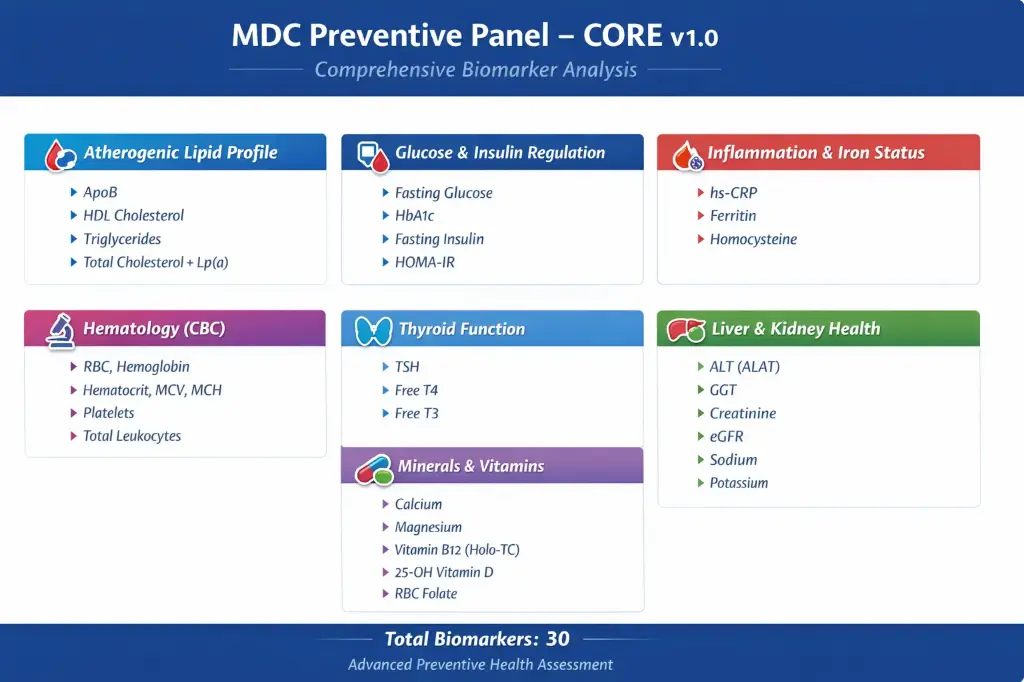
MDC - BioLab - Core Panel
Overview
MDC - BioLab - Core Panel is a laboratory marker panel focused on key cardiometabolic measurements. It includes Apolipoprotein B (ApoB), HDL cholesterol, triglycerides, and fasting glucose. The purpose is to provide structured data that can be tracked over time alongside lifestyle choices.
Cardiovascular and lipid context
ApoB is commonly used to reflect the number of atherogenic lipoprotein particles in circulation. HDL cholesterol is often reviewed as part of a standard lipid profile to contextualize lipid transport. Triglycerides add information about circulating fats that can vary with diet, alcohol intake, and overall energy balance.
Cholesterol-focused tracking
Looking at ApoB together with HDL cholesterol can help create a more complete picture than a single lipid value alone. This combination is frequently used to support informed conversations about nutrition patterns and activity levels. The panel is intended for monitoring and education rather than making any medical claim.
Glucose and metabolic snapshot
Fasting glucose provides a baseline measurement taken in a fasted state, which can improve comparability between tests. It can be used to track how consistent lifestyle habits relate to day-to-day metabolic status. When considered alongside triglycerides, it can offer additional context for overall metabolic patterns.
How to use results
These markers are most useful when measured consistently and interpreted as trends rather than isolated numbers. Many people pair results with changes in diet quality, physical activity, sleep routines, and stress management. For individualized interpretation, results should be reviewed with a qualified healthcare professional.
| Class | Ingredient | Quantity | NRV% |
|---|---|---|---|
| Atherogenic Lipid | Apolipoprotein B (ApoB) | 1.0 Stuk(s) | 0.0 |
| Atherogenic Lipid | HDL cholesterol | 1.0 Stuk(s) | 0.0 |
| Atherogenic Lipid | Triglycerides | 1.0 Stuk(s) | 0.0 |
| Glucose & Insulin Regulation | Fasting glucose | 1.0 Stuk(s) | 0.0 |
| Glucose & Insulin Regulation | HbA1c | 1.0 Stuk(s) | 0.0 |
| Glucose & Insulin Regulation | Fasting insulin | 1.0 Stuk(s) | 0.0 |
| Glucose & Insulin Regulation | HOMA-IR (calculated) | 1.0 Stuk(s) | 0.0 |
| Inflammation & Recovery Tone | hs-CRP | 1.0 Stuk(s) | 0.0 |
| Inflammation & Recovery Tone | Ferritin | 1.0 Stuk(s) | 0.0 |
| Inflammation & Recovery Tone | Homocysteine | 1.0 Stuk(s) | 0.0 |
| Thyroid & Energy Axis | TSH | 1.0 Stuk(s) | 0.0 |
| Thyroid & Energy Axis | Free T4 | 1.0 Stuk(s) | 0.0 |
| Thyroid & Energy Axis | Free T3 | 1.0 Stuk(s) | 0.0 |
| Liver Function | ALT (ALAT) | 1.0 Stuk(s) | 0.0 |
| Liver Function | GGT | 1.0 Stuk(s) | 0.0 |
| Renal Function | Creatinine | 1.0 Stuk(s) | 0.0 |
| Renal Function | eGFR (calculated) | 1.0 Stuk(s) | 0.0 |
| Micronutrient Status | 25-OH Vitamin D | 1.0 Stuk(s) | 0.0 |
| Micronutrient Status | Vitamin B12 (Holo-TC preferred) | 1.0 Stuk(s) | 0.0 |
| Micronutrient Status | RBC Folate | 1.0 Stuk(s) | 0.0 |
| Micronutrient Status | Magnesium (serum) | 1.0 Stuk(s) | 0.0 |
| Renal Function | Sodium | 1.0 Stuk(s) | 0.0 |
| Renal Function | Potassium | 1.0 Stuk(s) | 0.0 |
| Micronutrient Status | Calcium | 1.0 Stuk(s) | 0.0 |
| Micronutrient Status | Magnesium | 1.0 Stuk(s) | 0.0 |
| Atherogenic Lipid | Total Cholesterol | 1.0 Stuk(s) | 0.0 |
| Hematology & Oxygen | Erythrocytes (RBC) | 1.0 Stuk(s) | 0.0 |
| Hematology & Oxygen | Hemoglobin | 1.0 Stuk(s) | 0.0 |
| Hematology & Oxygen | Hematocrit | 1.0 Stuk(s) | 0.0 |
| Hematology & Oxygen | MCV | 1.0 Stuk(s) | 0.0 |
| Hematology & Oxygen | MCH | 1.0 Stuk(s) | 0.0 |
| Hematology & Oxygen | Platelets | 1.0 Stuk(s) | 0.0 |
| Hematology & Oxygen | Leukocytes (Total) | 1.0 Stuk(s) | 0.0 |
Capsules Ingredients:
Allergens:
| Title | Description |
|---|---|
| Pregnancy or breastfeeding – Low Risk | This is a lab marker panel, but testing and interpretation during pregnancy or breastfeeding should be guided by a healthcare professional. |
| Known bleeding disorder – Low Risk | If blood draw is required, individuals with bleeding disorders may need additional precautions. |
| Needle phobia or history of fainting with blood draws – Medium Risk | Blood collection can trigger vasovagal reactions in susceptible individuals. |
| Severe anemia or very low blood volume – Medium Risk | Blood sampling may be less well tolerated and should be discussed with a clinician. |
| Active infection at venipuncture site – Medium Risk | Skin infection near the draw site can increase the risk of local complications. |
| Title | Description |
|---|---|
| Bruising at draw site – Low Risk | Minor bruising can occur after venipuncture. |
| Temporary soreness – Low Risk | Mild arm soreness may occur for a short time after the blood draw. |
| Dizziness or fainting – Medium Risk | Some people may feel lightheaded during or after blood collection. |
| Local bleeding – Low Risk | A small amount of bleeding can occur at the puncture site, especially if pressure is not maintained. |
| Rare local infection – Low Risk | Infection is uncommon but possible if aftercare instructions are not followed. |
| Title | Description |
|---|---|
| Anticoagulants/antiplatelets – Medium Risk | Blood thinners can increase bruising or bleeding risk during blood collection. |
| Insulin or glucose-lowering medicines – Medium Risk | Fasting for a glucose test may require individualized planning to avoid low blood sugar. |
| Systemic corticosteroids – Low Risk | These medicines can influence glucose and lipid markers, affecting interpretation of results. |
| Lipid-lowering medicines (e.g., statins, fibrates) – Low Risk | These medicines can change ApoB, HDL cholesterol, and triglycerides, so results should be interpreted in that context. |
| Title | Description |
|---|---|
| General supplement warning – Low Risk | Food supplements should not be used as a substitute for a varied and balanced diet and a healthy lifestyle. |
| Daily dose warning – Low Risk | Do not exceed the recommended daily intake. |
| Children warning – Low Risk | Keep out of reach of young children. |
| Fasting requirement warning – Medium Risk | If fasting is required for the test, follow the lab instructions and seek advice if you use glucose-lowering medication. |
| Blood draw precaution – Medium Risk | If you use anticoagulants/antiplatelets or have a bleeding tendency, inform the phlebotomist before sample collection. |
| Manufacturing trace warning – Low Risk | May contain very small amounts of allergens due to shared production equipment, even when not present in the ingredient list. |
| Title | Description | Bioavailability |
|---|---|---|
| Apolipoprotein B (ApoB) | Laboratory biomarker used to quantify ApoB-containing lipoprotein particles for cardiometabolic tracking. | Not applicable (laboratory measurement, not an ingested ingredient). |
| HDL cholesterol | Laboratory biomarker used to report HDL cholesterol levels as part of lipid status monitoring. | Not applicable (laboratory measurement, not an ingested ingredient). |
| Triglycerides | Laboratory biomarker used to report circulating triglyceride levels for lipid and metabolic context. | Not applicable (laboratory measurement, not an ingested ingredient). |
| Fasting glucose | Laboratory biomarker used to measure baseline blood glucose in a fasted state for metabolic tracking. | Not applicable (laboratory measurement, not an ingested ingredient). |
| Allergen | Source Ingredient | Mandatory | Inference |
|---|---|---|---|
| None | None | No | None |
Population & target users: Adults who want to track core lipid and fasting glucose markers for general wellness monitoring.
How to take: Follow the laboratory’s instructions for sample collection; if fasting is required, avoid caloric intake for the specified period and maintain usual hydration unless instructed otherwise.
Duration of use: Use as a one-time panel or repeat at intervals recommended by a qualified professional to observe trends.
Storage & conservation: Not applicable for a lab panel; follow the lab’s guidance for appointment timing and sample handling.

Voordelen

Cardiovascular
This core panel is designed to support cardiovascular wellness tracking by measuring Apolipoprotein B (ApoB), HDL cholesterol, and triglycerides. These markers are commonly used to contextualize lipid transport and circulating fat levels as part of a broader lifestyle plan. Results can be used to guide discussions with a qualified professional about diet, activity, and overall risk-factor management.
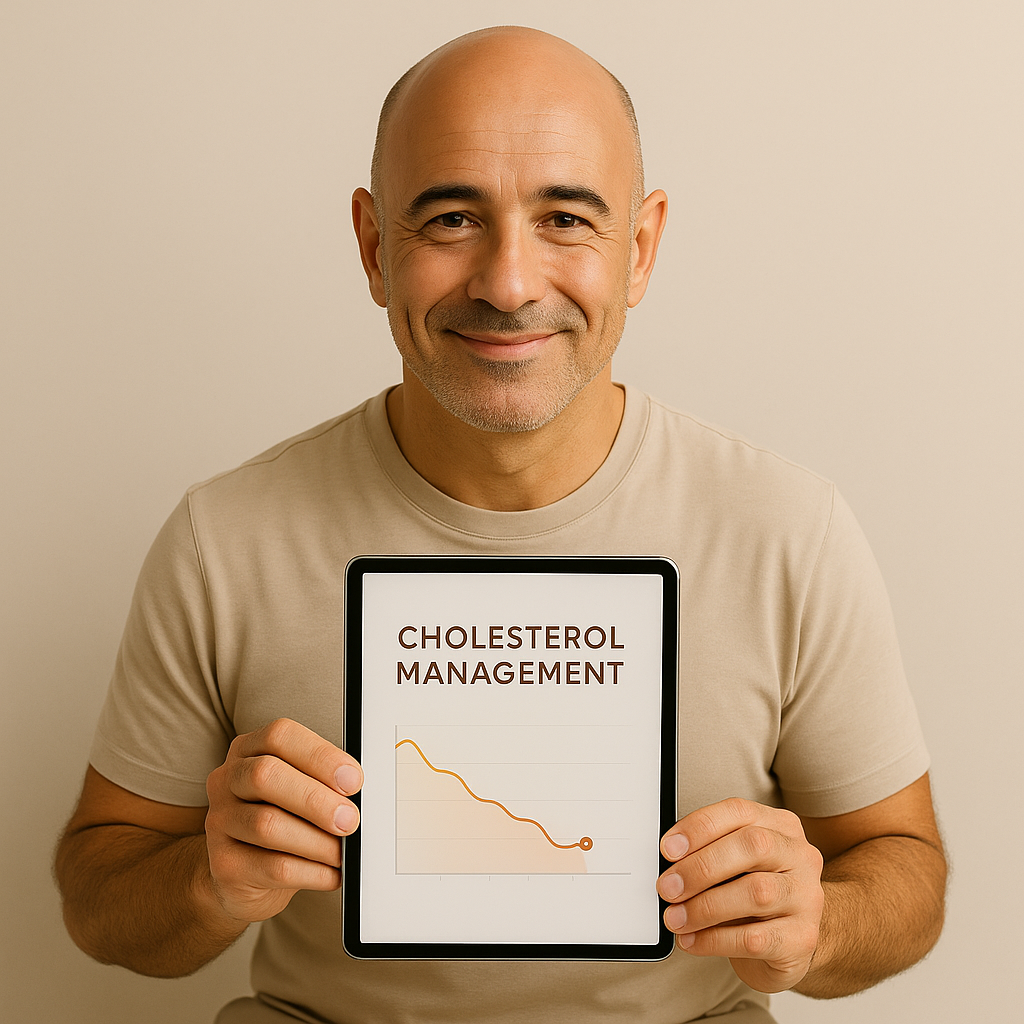
Cholesterol Management
HDL cholesterol and Apolipoprotein B (ApoB) provide complementary information about cholesterol-carrying particles and lipid balance. This can be useful for people who want a structured way to monitor how nutrition and exercise routines relate to their lipid profile over time. Triglycerides add additional context for how the body is handling circulating fats.

Blood Sugar Support
Fasting glucose is included to help track baseline glucose status in a consistent, fasted state. This can support general wellness goals related to meal timing, carbohydrate choices, and activity habits. When viewed alongside triglycerides, it can provide broader metabolic context without implying any medical outcome.
Metabolism Support
By combining fasting glucose with triglycerides, the panel offers a simple snapshot that can be used to reflect on energy balance and metabolic lifestyle factors. These measurements can be repeated periodically to observe trends alongside changes in diet, sleep, and physical activity. ApoB and HDL cholesterol add additional context for how metabolism relates to lipid transport.

Overall Health
This panel can be used as a general check-in tool for people who want objective data points related to lipids and fasting glucose. ApoB, HDL cholesterol, triglycerides, and fasting glucose are often reviewed together as part of a broader wellness picture. The results are best interpreted with consideration of personal history and lifestyle factors.